Comprehensive Dental Exam in Petaluma: What to Expect
August 7, 2026 9:00 amA dental exam can sound pretty straightforward. You sit back, open wide, and wait to hear whether everything looks healthy. But a comprehensive dental exam gives Dr. Serrano a much closer look at your teeth, gums, bite, existing dental work, and the tissues throughout your mouth.
At Alma Dental Care in Petaluma, we use that visit to establish a clear picture of your oral health. Maybe one tooth has started feeling sensitive, perhaps your gums bleed when you floss, or maybe it has simply been a while since your last dental appointment. Even when nothing hurts, a comprehensive exam can uncover cavities, gum changes, worn dental work, and other concerns that are easier to address earlier.
Just as importantly, you do not have to arrive knowing exactly what is wrong. If something feels different, tell us. A tooth that catches floss, sensitivity to cold, jaw soreness, a rough filling, or a change in your bite can all give Dr. Serrano useful information as the exam gets underway.
Your Visit Starts With a Conversation
Before Dr. Serrano starts examining your teeth, we will review your dental and health history. That includes medications, previous dental treatment, current concerns, and any changes you have noticed since your last visit. If you are new to Alma Dental Care, this also helps us understand where you are starting.
This is the time to mention the little things you may have been noticing at home. Maybe ice water suddenly bothers one tooth, chewing feels different on one side, or your gums have started bleeding in the same area. You do not need to diagnose it yourself; describing what you feel helps us know where to take a closer look.
And if you have been away from the dentist for several years, you can simply tell us that too. We will look at what is happening now and go from there. There is plenty to learn from the current condition of your mouth without dwelling on how long it has been since the last appointment.
Dental X-Rays Help Us See Beyond the Surface
Some dental problems cannot be seen just by looking in the mouth. X-rays allow Dr. Serrano to see between teeth, around the roots, beneath restorations, and into the bone supporting the teeth. They are an important part of a comprehensive evaluation because they fill in areas the clinical exam cannot show on its own.
For a new patient, current dental images are typically needed so we can establish a useful baseline and evaluate areas that have not yet been examined at Alma Dental Care. If you recently had diagnostic X-rays taken elsewhere, those images may be useful if they are current and provide the information Dr. Serrano needs. Otherwise, we can take the appropriate images during your visit.
From there, the X-rays and clinical exam work together. An image may show a cavity developing between two teeth that look normal from the outside, while another may reveal bone changes around a tooth with gum concerns. Dr. Serrano can then compare what appears on the images with what she sees and feels during the exam.
Dr. Serrano Examines Each Tooth Closely
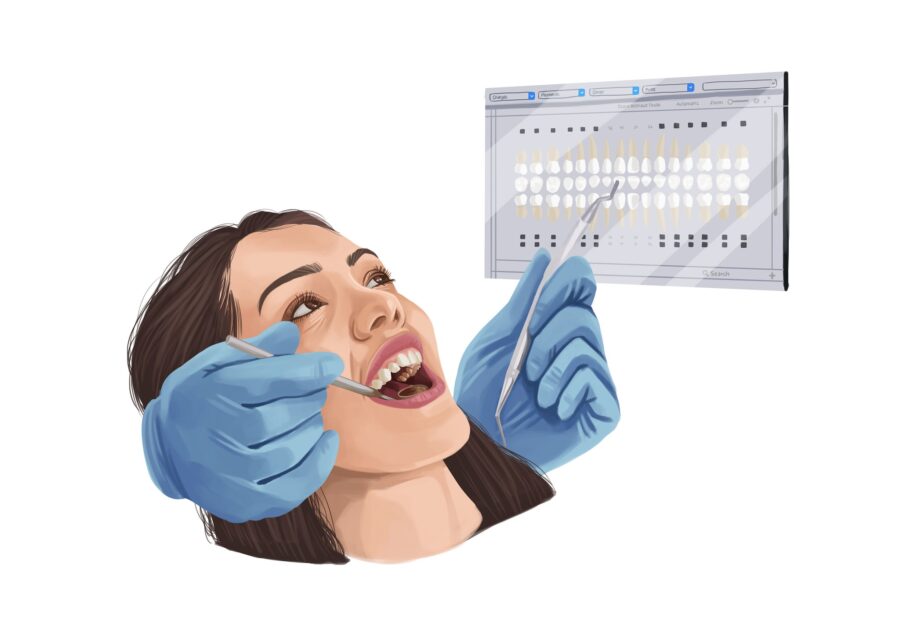
Once the images are available, Dr. Serrano will examine the teeth one by one. She looks for cavities, cracks, chipped areas, enamel wear, and other changes in the tooth structure. Existing fillings, crowns, bridges, and other restorations are checked at the same time.
Older dental work deserves attention even when it feels fine. A filling can develop a small gap around the edge, a crown may begin to wear, or decay can start in an area that is difficult to see at home. Catching those changes earlier may give us more options for repairing the tooth.
If you came in with a specific symptom, Dr. Serrano can spend extra time evaluating that area. For example, pain when biting can have several possible causes, while sensitivity to cold may point in a different direction. The exam and X-rays help narrow down what is actually happening.
Your Gums Get a Full Periodontal Assessment
A comprehensive dental exam also includes a periodontal assessment. We look closely at the gums for bleeding, swelling, recession, and buildup around the gumline. In addition, we measure the spaces around the teeth to check the health of the gums and supporting tissues.
Those measurements help us identify signs of gingivitis or periodontal disease that may not be obvious to you yet. Gum disease can develop without significant pain, so waiting until something hurts is not a reliable way to catch it. Bleeding while brushing or flossing can be one clue, but the periodontal measurements give us much more information.
The findings also help determine what type of cleaning is appropriate. If the gums and supporting tissues are healthy, a routine dental cleaning may be recommended. However, deeper pockets, inflammation, or bone loss may call for periodontal treatment instead.
We Also Look at How Your Teeth Come Together
Teeth do not work independently. Every time you chew, swallow, or clench, the upper and lower teeth come together in a particular pattern. So, Dr. Serrano also looks at your bite and watches for signs that certain teeth may be taking more pressure than others.
Flattened edges, small chips, worn enamel, or repeated cracks can sometimes point to clenching or grinding. Meanwhile, one tooth that hits a little harder than the others can become sore when you bite. A filling or crown may also affect the bite if the contact has changed.
If you wake up with a tired jaw, notice headaches in the morning, or have been told that you grind your teeth, mention it during the exam. Those details can help Dr. Serrano connect what you are feeling with the wear patterns she sees. If needed, a custom nightguard or another treatment can be discussed.
Existing Fillings, Crowns, and Other Dental Work Are Checked Too
Dental restorations are designed to last, but they still need to be examined over time. Fillings can wear around the edges, crowns can loosen, and decay can sometimes develop around older dental work. Even a restoration that still looks fine in the mirror may need a closer look.
Dr. Serrano checks for rough edges, cracks, open margins, wear, and changes in the surrounding tooth. X-rays can also help show what is happening around or beneath certain restorations. If something looks questionable, she can explain whether it needs treatment now or can be monitored.
You do not need a complete history of every filling or crown you have ever had. If you remember when something was placed, that information is helpful, but it is not required. We can still evaluate how the tooth and restoration are doing today.
Your Comprehensive Exam Includes an Oral Cancer Screening
The exam goes beyond the teeth and gums. Dr. Serrano also checks the lips, tongue, cheeks, palate, gums, and other tissues in the mouth for unusual changes. That may include sores that are not healing, unusual color changes, lumps, or areas that look different from the surrounding tissue.
Most small mouth sores are harmless and clear up on their own. However, an area that persists or changes deserves attention. Regular dental visits give us a chance to notice those changes even when they are not causing discomfort.
If Dr. Serrano sees something that needs a closer look, she can explain what she is seeing and what should happen next. Sometimes an area simply needs to be monitored. In other cases, additional evaluation may be recommended.
The Cleaning and Exam Work Hand in Hand
A comprehensive exam is often paired with a professional cleaning, although the type of cleaning depends on the periodontal findings. When the gums are healthy, a routine cleaning removes plaque and tartar from areas that brushing and flossing may miss. The teeth are also polished to remove surface buildup.
If the periodontal assessment shows gum disease, the cleaning recommendation may change. Deeper pockets, inflammation, and buildup below the gumline can require more involved periodontal care. That is why measuring the gums before deciding on the appropriate cleaning is so useful.
Meanwhile, the exam gives Dr. Serrano a chance to evaluate what is happening beneath and around that buildup. A cleaning may leave your teeth feeling smoother, but the comprehensive exam tells us whether there are cavities, gum changes, worn restorations, or other concerns that need attention.
Preventive Care May Be Added When It Makes Sense
Depending on what we find, Dr. Serrano may recommend additional preventive care. Fluoride treatment can help strengthen enamel and may be useful if you have a history of cavities, exposed roots, dry mouth, or other factors that increase your risk of decay. Dental sealants may also be useful for certain teeth with deep grooves that are difficult to keep clean.
Those recommendations come after we look at your individual cavity history and current oral health. Someone who rarely develops cavities may need a different approach than someone who seems to get one at nearly every visit. The same is true for gum care.
Home habits can be discussed here too. If plaque is consistently collecting in one area, we can show you a better way to reach it with brushing or flossing. A small change in technique can sometimes make cleaning that spot much easier between visits.
If We Find a Cavity or Another Problem, We Will Talk Through It
Not every comprehensive exam ends with treatment. Sometimes the teeth and gums are healthy, and the next step is simply continuing routine preventive care. Other times, Dr. Serrano may find a cavity, cracked tooth, gum disease, or restoration that needs attention.
If something does need treatment, she can show you what she found and explain the available options. A small cavity may need a filling, while a weakened tooth may need a crown. Gum disease, meanwhile, may require periodontal treatment before returning to routine maintenance.
If several things need attention, they do not always have to be handled at once. Urgent problems can be addressed first, while less pressing treatment can often be planned afterward. That gives you a clear sense of what should happen now and what can be scheduled later.
A Comprehensive Exam Is Useful Even When Nothing Hurts
Dental problems are not always noisy. A cavity can develop without causing pain, gum disease may progress quietly, and a filling can begin wearing down before you notice any change. Regular exams allow us to catch those concerns while they are still small enough to have more treatment options.
Seeing you consistently also gives Dr. Serrano something to compare from one visit to the next. X-rays can be reviewed alongside previous images, periodontal measurements can be tracked, and small changes in enamel or restorations can be followed over time. That history becomes especially useful when an area is changing slowly.
So, if your mouth feels fine, that is good news—but it is still worth checking. Preventive dental care works best when we are not waiting for a tooth to become painful before taking a look.
What Should You Mention During Your Exam?
You know what your mouth feels like every day, so changes you notice at home can be very useful during the visit. Even symptoms that seem minor are worth mentioning. They may help Dr. Serrano focus on an area that otherwise looks fairly normal at first.
Be sure to tell us about things such as:
- New sensitivity to hot, cold, or sweets
- Pain when biting or chewing
- Bleeding gums
- A filling or crown that feels rough or loose
- Food getting stuck in the same place
- Jaw soreness or frequent clenching
- A tooth that suddenly feels different in your bite
- A sore or irritated area that is not healing
You can also bring up questions that are not related to pain. Maybe you are interested in whitening, Invisalign, replacing an old restoration, or simply improving your home-care routine. A comprehensive exam gives Dr. Serrano a chance to look at the current health of your mouth before discussing what may be appropriate.
If Dental Visits Make You Nervous, Tell Us
Some people are comfortable in a dental chair, while others arrive with a little more tension in their shoulders. Maybe you had an unpleasant experience years ago, or perhaps you simply prefer knowing what is happening before anyone starts working. Either way, tell us.
We can explain what we are checking as the exam moves along and answer questions before moving to the next part. If you need a brief pause, that is fine too. A comprehensive visit already involves several different parts, so there is no reason to rush through them.
Knowing what to expect can also make the appointment feel less uncertain. You will move through a health-history review, X-rays, the tooth-by-tooth exam, periodontal measurements, bite evaluation, and oral tissue screening. By the end, you should have a clear picture of what looks healthy and what, if anything, needs attention.
Your First Comprehensive Exam May Take a Little Longer
If you are new to Alma Dental Care, your first visit usually involves more information gathering than a routine return appointment. We need time to review your health history, discuss previous dental treatment, take or review appropriate X-rays, and establish baseline periodontal measurements. Dr. Serrano then has enough information to evaluate your overall oral health thoroughly.
Future X-rays can be compared with the first set, gum measurements can be tracked, and existing dental work can be monitored for changes over time. A periodontal pocket that deepens, a restoration that begins to wear, or a small change in bone level can be easier to recognize when there is an earlier record for comparison. As you continue with regular care, those records give Dr. Serrano a clearer view of how your oral health is changing.
And if you are coming back to dentistry after a long break, there is no need to have everything figured out beforehand. Tell us what has been bothering you, if anything, and we will start with a comprehensive evaluation. From there, Dr. Serrano can explain what looks healthy, what should be watched, and what may need treatment.
Schedule a Comprehensive Dental Exam at Alma Dental Care in Petaluma
A comprehensive dental exam looks at much more than whether you have a cavity. Dr. Serrano evaluates your teeth, gums, periodontal measurements, bite, existing restorations, X-rays, and the soft tissues throughout your mouth. At the same time, you have the chance to bring up sensitivity, jaw discomfort, cosmetic concerns, or anything else that has changed since your last visit.
At Alma Dental Care in Petaluma, we use comprehensive exams to build a clear picture of your oral health before recommending care. If something does need attention, Dr. Serrano can explain what she found and walk you through the next step. If everything looks healthy, we can help you keep it that way with regular preventive visits.
If you are new to the office, overdue for a dental checkup, or simply ready for a more complete look at your oral health, schedule a comprehensive dental exam with Alma Dental Care in Petaluma. Bring any questions or concerns you have noticed at home, and we will make sure they get a closer look.
Contact UsImage from Authority Dental under CC 2.0
Categorised in: Preventive Dental Care